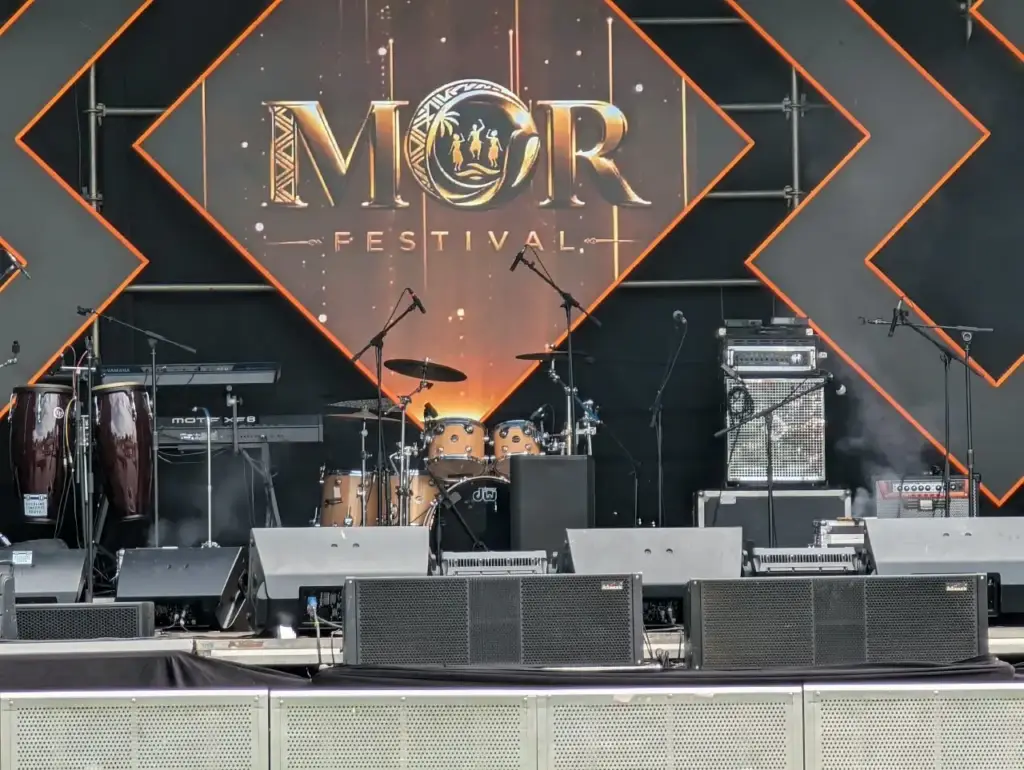
Line arrays are the default at large events, and often requested at events far too small to need one. Understanding what they actually do makes it easier to know whether you need one.
What a line array is doing
A line array is a column of loudspeaker elements arranged and angled so their outputs combine into a single coherent wavefront. Because of how that combined output behaves, level falls away far more slowly with distance than it does from a single box. In practice that means the person at the back of a field hears something close to what the person twenty metres from the stage hears.
Why that matters for big audiences
With conventional stacked speakers, making the back of a large crowd audible means making the front painfully loud. A properly designed and angled array narrows that gap. The angles between elements are not decorative: they are set from a coverage model of your specific site, which is why the design work happens before anything is loaded onto a truck.
What an array demands in return
Arrays need somewhere to hang from, or a certified ground-stack arrangement, and they need people qualified to rig them. They need time, usually a full day of build for a substantial system. They need power planned properly. Outdoors they need wind loading considered before they are left flown. None of this is exotic, but it does mean an array is not a same-morning solution.
When a line array is the wrong answer
For audiences under a few hundred in a normal room, a well-placed point-source or column system will usually sound better and cost far less, because the room does not need the extra reach. Requesting an array for a 200-guest ballroom mostly buys rigging complexity. A supplier who talks you out of an array you do not need is worth keeping.
How to tell if your event needs one
Rough guide: if the audience runs deeper than about twenty-five metres from the stage, or you are covering well over a thousand people, an array starts to make sense. Below that, ask for a coverage plan for both options and compare. The honest answer depends on the shape of your site, which is why we ask for a venue and a headcount before quoting anything.